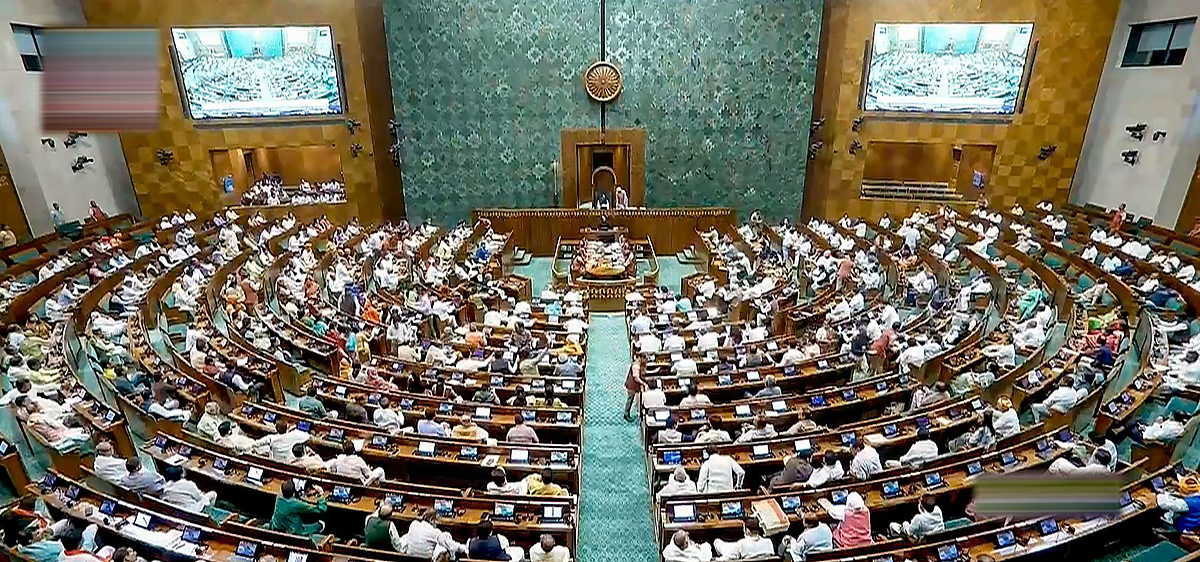

India is headed toward one of its messiest political fights in years. After the 2026 census, the country will redraw its parliamentary and state assembly constituencies for the first time since 1971, a process called delimitation. It’s constitutionally required. It’s also deeply unpopular in large parts of the country, and the tension is already spilling into the open. The loudest voice right now is Tamil Nadu Chief Minister MK Stalin, who convened a Joint Action Committee meeting in Chennai on March 22, 2025, pulling together states that believe delimitation, done badly, could gut their representation in Parliament. Whether you see that as principled federalism or regional politics depends on where you sit, but either way, the debate is real and the stakes are high. So what is delimitation actually, why does it cut this deep, and what does it mean for a democracy as varied as India’s? That’s what this piece works through.
What is Delimitation?
Delimitation, in simple terms, is the redrawing of electoral boundaries to reflect shifts in population, ensuring fair representation in legislative bodies like the Lok Sabha and state assemblies. In India, this process is overseen by the Delimitation Commission, an independent body established under the Delimitation Act (last reconstituted in 2002). The commission adjusts the number of seats and their geographic boundaries based on the latest census data, a task rooted in Articles 82 and 170 of the Indian Constitution, which govern the allocation of seats in the Lok Sabha and state legislatures, respectively.
Historically, delimitation occurred after the censuses of 1951, 1961, and 1971. However, the 42nd Amendment in 1976 froze the process, fixing seat allocations based on the 1971 Census to encourage states to pursue population control without losing political clout. This freeze was extended by the 84th Amendment in 2001 until after the first census post-2026, likely the delayed 2021 Census, now expected in 2026. Once lifted, the next delimitation will realign seats to reflect India’s current population, which has grown unevenly across its states.
The Constitutional Mandate and the Risks of Inaction
The Constitution doesn’t spell out what happens if delimitation gets indefinitely postponed. But Articles 82 and 170 tie seat allocation to census data, and the implication is clear enough, this is meant to be a recurring process, not a one-time fix. The Supreme Court has said as much on occasion, flagging timely delimitation as a matter of democratic fairness. The problem is that “fair” means different things depending on which state you’re standing in.
If nothing changes, India keeps running on a 1971 electoral map. That’s 543 Lok Sabha seats frozen in a demographic snapshot that’s over fifty years old. For Tamil Nadu, Kerala, Andhra Pradesh, Telangana, and Punjab states that brought their population growth under control, the freeze is quietly advantageous. For Uttar Pradesh and Bihar, where populations have roughly doubled or more since then, it means chronic underrepresentation. Their people exist; their seats don’t reflect it. Post-2026 estimates suggest the Lok Sabha may need to expand to over 800 seats to meaningfully account for 1.4 billion people. That’s not a minor adjustment. It’s a fundamental shift in where political weight sits, and everyone involved knows it.
Who Stands to Lose the Most?
The numbers tell a stark story. States in India’s south and parts of the east and northeast, which successfully implemented family planning, face a potential loss of parliamentary seats if delimitation hinges solely on population. Tamil Nadu, with 39 Lok Sabha seats and a population of about 72 million (2011 Census), could see its share drop to 31. Kerala, with 20 seats, and Andhra Pradesh, with 25, might also lose ground. Conversely, Uttar Pradesh, with 80 seats and a population nearing 240 million (projected 2026), could gain up to 143 seats, per NDTV’s analysis. Bihar, with 40 seats, might climb to 70.
This shift threatens to tilt India’s political balance northward, where population growth outpaces development metrics like literacy and GDP contribution. Southern states, which contribute disproportionately to India’s economy, fear a diluted voice in Parliament; Tamil Nadu alone accounts for 8.5% of the national GDP with just 6% of the population. The BBC highlights this north-south divide as a “demographic faultline,” noting that southern leaders like Stalin see it as punishment for progress.
Possible Solutions: Balancing Equity and Federalism
There’s no shortage of ideas. What’s missing is agreement on any of them.
Extend the freeze: Stalin’s JAC wants to push the 1971-based seat count forward another 25 to 30 years. It’s the simplest option politically for the South and the most frustrating one for northern states that have been underrepresented for decades already. Kicking the can works until it doesn’t.
Expand the total seats: If the Lok Sabha grows to 848 or even 1,000 seats, states like Tamil Nadu don’t necessarily lose what they have, they just gain less than UP and Bihar do. The math looks gentler. But the new Parliament building tops out at 888 Lok Sabha seats, so “expand to 1,000” isn’t just a political decision; it’s a construction project. And even at 848, Tamil Nadu’s share of the room shrinks relative to the north. More seats for everyone isn’t the same as equal influence.
Use a hybrid formula: Instead of counting heads alone, weight the seat calculation around population, geographic area, economic output, and human development indicators. This would soften the blow for states that invested in their people. It would also immediately invite accusations that the formula was designed backward from the desired outcome, because it would be, at least partly. That’s not necessarily wrong, but it’s a hard thing to defend in court or in public.
Cap what any state can gain: Put a ceiling on how many additional seats Uttar Pradesh or Bihar can pick up, say, 100 maximum for UP. It limits the northward tilt without stripping anyone of existing representation. Whether it survives a constitutional challenge is another question. The equality provisions cut both ways.
Reform the Rajya Sabha: Give the upper house more real power in national decision-making, so states have structural leverage that doesn’t depend entirely on Lok Sabha seat counts. This is the most indirect route and probably the longest one. It also requires the kind of institutional reform that Indian politics rarely manages quickly.
Build consensus first: All-party meetings, broad consultations, and a genuine attempt to find terms everyone can live with before the Delimitation Commission starts drawing lines. Reasonable in theory. In practice, “national consensus” on something this politically loaded is a high bar in any country, let alone one as divided as India is right now.
None of these is clean. The freeze buys time but solves nothing. Expansion has a physical ceiling and doesn’t fully address the influence problem. Hybrid models are defensible in principle and messy in execution. Caps invite litigation. Rajya Sabha reform is slow. And consensus? Well, the fact that Stalin had to convene a JAC in the first place suggests how far away that is.
The Chennai Meeting: Southern States Find Their Voice
The meeting at ITC Grand Chola on March 22 was, by any measure, a significant event. Stalin had pulled together Kerala’s Pinarayi Vijayan, Telangana’s Revanth Reddy, Punjab’s Bhagwant Mann, Karnataka’s DK Shivakumar, and party delegates from Odisha’s BJD, Telangana’s BRS, and Punjab’s Shiromani Akali Dal. Fourteen leaders across five states, all in one place, all with the same basic anxiety about what post-2026 delimitation does to their political weight. West Bengal was invited. Trinamool Congress didn’t come.
Stalin’s framing was deliberate. This wasn’t opposition to delimitation; he was careful to say that repeatedly. The ask was fairness in how it’s done. He floated renaming the group the “Fair Delimitation JAC” to make the point stick. DMK MP Kanimozhi read the resolution aloud: Tamil Nadu has halved its fertility rate since 1971. That happened because the state invested in women’s education, healthcare, and family planning over decades. Losing parliamentary seats because of that investment is, by any reasonable reading, a perverse outcome.
Vijayan called the Centre’s approach a “narrow political move.” Odisha’s Naveen Patnaik, speaking through BJD delegates, said population alone shouldn’t drive the formula. The group left with plans for public awareness campaigns and a follow-up meeting in Hyderabad.
What the BJP says and why it hasn’t landed
The BJP’s response has been to wave the whole thing away as political theater. Amit Shah has said no state will lose seats. That assurance has been repeated enough times that it’s clearly meant to settle the debate.
It hasn’t. “No state will lose seats” is a promise without a mechanism behind it. How? Through expansion? Through a hybrid formula? Through capping northern gains? Shah hasn’t said. And in the absence of detail, southern states are left to take it on faith that a central government, whose electoral base sits overwhelmingly in the north, will design a delimitation process that protects southern representation. That’s a lot to ask.
The federalism problem underneath all of this
The delimitation fight is really a federalism fight wearing electoral clothes. If northern states come to dominate the Lok Sabha by sheer demographic weight, the policy consequences follow: budget allocations, education priorities, healthcare spending, language policy, and economic planning. These aren’t abstract concerns. Southern states contribute disproportionately to national tax revenues and receive less back in transfers, a grievance that predates this delimitation cycle by decades. Adding a permanent parliamentary disadvantage on top of that is what’s driving the alarm.
Stalin’s JAC probably can’t stop delimitation from happening. The Constitution requires it, the census is coming, and the political math in Delhi doesn’t favor the south. But the coalition has already done something; it has made this a public fight rather than a technocratic one conducted quietly inside a commission. Legal challenges are being prepared. Awareness campaigns are being planned. The next meeting is already scheduled.
Whether India finds a formula that doesn’t effectively penalize states for developing faster than the national average or locks in a north-south divide that compounds over the coming decades, is the real question sitting behind all the arguments about seat counts and census data. It doesn’t have an easy answer. But it’s no longer a question being asked quietly.
By Raghavendar Askani (The author is the Director of Swatantrata Center.)