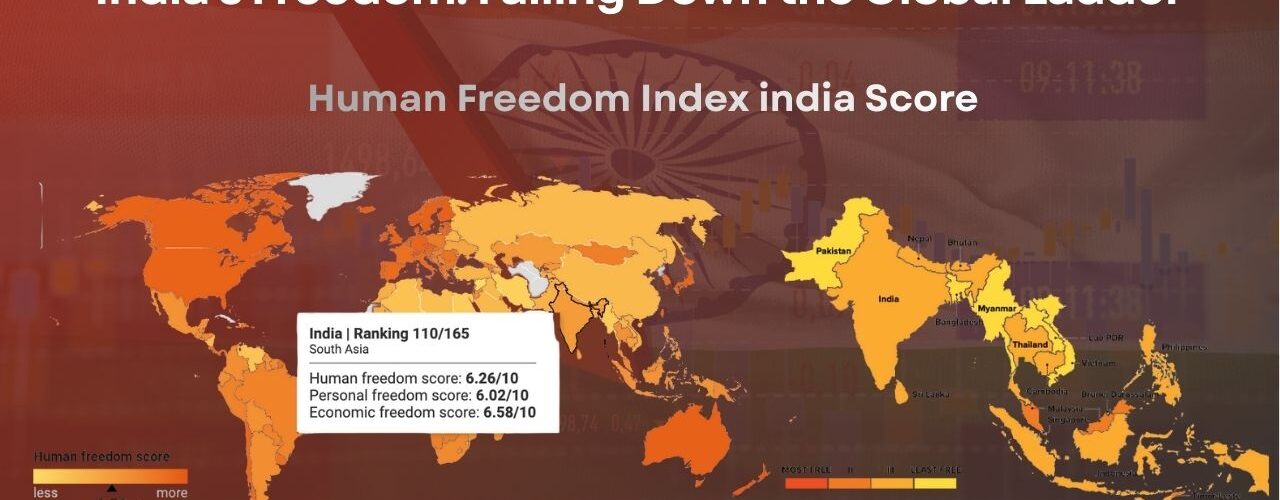

The 2025 Human Freedom Index, published by the Cato Institute and the Fraser Institute, ranks India 110th out of 165 countries, indicating a decline in its standing on personal and economic freedoms. New data reveals a concerning trend for India, the world’s largest democracy. Ranked 87th in 2014, India has since fallen 23 places, indicating a decline in civil liberties that undermines its economic growth.
A Decade of Decline:
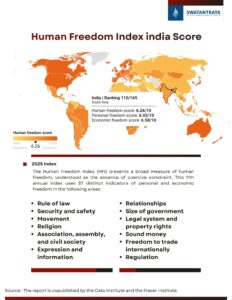
The 2025 report uses data from 2023, the most recent year for which comprehensive global statistics are available. It measures freedom through 87 distinct indicators, ranging from the rule of law and religious freedom to the ability to trade and start a business.
India’s current rank of 110 follows a similar low in the 2023 index (based on 2021 data), where the country was ranked 109th. While there was a slight numerical shift, the broader picture remains static: India is stuck in a cycle of democratic backsliding. The report highlights that while India has attempted to maintain some level of economic freedom, its “Personal Freedom” scores have faced severe declines.
Areas like freedom of expression, freedom of religion, and the rule of law have been flagged as major pain points. Critics and researchers note that the harassment of journalists, the tightening of regulations on NGOs, and a rise in communal tensions have collectively dragged down the nation’s overall score.
The Freedom Gap: Economic vs. Personal
A striking feature of the report is the imbalance in India’s performance. On the economic front, India has seen some success, ranking 86th globally in economic freedom according to a separate annual report by the same institutes. However, this progress is being neutralized by a lack of personal freedom.
The HFI defines human freedom as the “absence of coercive constraint.” When citizens feel restricted in how they speak, worship, or move, the overall index score drops, regardless of how fast the GDP is growing. This “freedom gap” suggests that India’s economic potential may be hitting a ceiling because it is not supported by the institutional protections of personal liberty.
Global and Regional Context
India’s ranking is particularly noteworthy when compared to its neighbors and global peers. While India still ranks higher than Pakistan (147th) and China (149th), it trails significantly behind smaller neighbors like Nepal and Bhutan.
Globally, the 2025 report paints a somber picture. It notes that nearly 90% of the world’s population has experienced a decline in freedom since the pandemic. However, India’s decline is not just a pandemic-era fluke; it is a decade-long slide that predates the global health crisis.
Why It Matters
The Cato Institute’s findings emphasize a strong link between freedom and prosperity. Nations in the top “freedom quartile” enjoy an average per capita income significantly higher than those at the bottom. For India, the message is clear: sustainable growth requires more than just policy reforms in the business sector.
As India continues to pitch itself as a global leader and a hub for international investment, these rankings serve as a reality check. The 2025 Human Freedom Index suggests that for India to truly advance, it must address the “invisible” constraints on its citizens. ensuring that personal liberty grows alongside the economy. Without a course correction in the rule of law and civil rights, India risks remaining a “partly free” nation in a world that increasingly values transparency and the protection of individual rights.