
Swatantrata Mini-Grants
Indic Liberalism Fellowship
The Swatantrata Center invites Expressions of Interest for the New Age Indic Liberalism Fellowship. This fellowship provides mini-grants to support students, researchers, academics, young professionals, and content creators working on projects exploring the relationship among liberty, human flourishing, and India’s intellectual and Dharmic traditions. The fellowship seeks to encourage high-quality research, writing, advocacy, and creative projects that deepen understanding of freedom in the Indian context.
Who Can Apply?
Academic Professionals: Master’s students, PhD scholars, researchers, lecturers, and early-career academics.
Young Professionals: Individuals working in public policy, law, economics, governance, social sciences, and related fields.
Content Creators: Writers, podcasters, journalists, social media creators, and individuals involved in public discourse.
Students: Undergraduate students with a demonstrated interest in classical liberalism, public policy, economics, governance, or Indic studies
Activities of Fellowship Themes
Applicants may submit projects under one of the following themes:

Emerging Technologies and Individual Freedom
Projects examining artificial intelligence, blockchain, Bitcoin, nuclear energy, and related technologies through the lens of freedom, innovation, and economic empowerment.

Indic Liberalism and Dharmic Governance
Projects exploring the historical, philosophical, and intellectual roots of liberty, governance, and human flourishing within Indian traditions.

Grassroots Advocacy and Economic Reforms
Projects that advance understanding of classical liberal ideas and promote economic reforms, entrepreneurship, civic engagement, and opportunity in India.

Supported Project Types
The fellowship supports a wide range of projects, including:
- Academic papers
- Dissertation or thesis work
- Paper presentations
- Policy op-eds
- Policy recommendations
- Podcasts
- Social media campaigns
- Advocacy events
- Other innovative project formats
Fellowship Support
Selected fellows may receive:
- Mini-grants of up to ₹25,000 (need-based)
- Mentorship and guidance
- Access to the Swatantrata Center network
- Support throughout the project period
Projects are expected to be completed within three months unless otherwise agreed.

Selection Process

Phase 1: Expression of Interest
Applicants submit an Expression of Interest outlining their project idea, timeline, and budget through the Google form.

Phase 2: Video Screening
Shortlisted applicants will be invited for a brief compatibility interview.

Phase 3: Selection and Funding
Successful applicants will receive fellowship support and begin project implementation.

Fellowship Reporting
To ensure accountability and successful project completion, fellows are expected to complete the following milestones:
Progress Report: A brief written update accompanied by a check-in call with the Swatantrata Center team.
Final Report: A short report summarizing project outcomes, deliverables, links, and evidence of completion, followed by a final review call.
Grant Details
- Maximum grant amount: up to ₹25,000 per project
- Funding is need-based
- Funds may be disbursed in multiple stages
- Maximum project duration: 3 months
- Applications accepted on a rolling basis
Why This Fellowship?
The fellowship aims to support individuals who are interested in exploring how the principles of liberty, human flourishing, and responsible self-governance can be understood and advanced within the Indian context.
Whether through research, writing, advocacy, policy work, or creative projects, the fellowship seeks to encourage ideas and initiatives that contribute to a freer and more prosperous society.

Introducing Indian Liberalism Fellows
PROJECT
Freedom to Flourish: Reimagining the Role of the State in India’s Economic Future

Gayatri Behera is a doctoral researcher in economics at the Central University of Odisha, with academic interests spanning sustainable development, inclusive growth, rural transformation, food security, and economic policy. Her research journey has brought together empirical economic analysis with a broader interest in how institutions and public policy can expand meaningful opportunities for individuals and communities. She has worked across teaching and research, including contributions to research on sustainable livelihoods, food security and rural transformation through millets, alongside research on environmental sustainability, digital transformation, and inclusive development. Her broader academic work explores how economic institutions and public policy can support participation, agency, and sustainable prosperity. As an Indic Liberalism Fellow, her project, “Freedom to Flourish: Reimagining the Role of the State in India’s Economic Future,” explores how the role of the state can be reimagined to create an enabling environment where individuals, communities, and enterprises can exercise greater economic agency while contributing to India’s development. My work is grounded in the belief that meaningful freedom is strengthened when people have the opportunity and institutional space to flourish.
PROJECT
Caste, Religious Legitimacy, and Institutional Entrepreneurship: Sree Narayana Guru’s Reform Movement in Kerala, 1888–1928

Vinayakan Sajeev Beena is an economist with an MSc in Economics and Public Policy (University of Bologna), formerly an open-innovation analyst at CRIF, and Editor-in-Chief of Libertas, the magazine of European Liberal Youth (LYMEC), the ALDE youth wing. He founded QueerEcon.org, hosts the Homocapitalism podcast, and serves on the Steering Committee of the European Committee for LGBTQ+ Economists. A recipient of the Salzburg Global and Mercatus Center (Bastiat, Lavoie) fellowships, he researches entrepreneurship and innovation, political economy, economic history, LGBTQ+ economics, and caste.
As an Indic Liberalism Fellow at the Swatantrata Center, he leads “Caste, Religious Legitimacy, and Institutional Entrepreneurship: Narayana Guru’s Reform Movement in Kerala, 1888–1928,” which opens with creative destruction: Guru shattering the Brahminical ritualistic monopoly by consecrating an Ezhava Shiva at Aruvippuram. It traces how religious legitimacy, education, enterprise, and voluntary association dismantled caste barriers — an economics of radical equality compressed in the Guru’s line: ഒരു യോനിയൊരാകാരം ഒരു ഭേദവുമില്ലതില് — one womb, one form, no difference therein.
PROJECT
Civilisational Libertarianism: Reinterpreting Freedom and Governance Through Bharatiya Wisdom for Viksit Bharat 2047
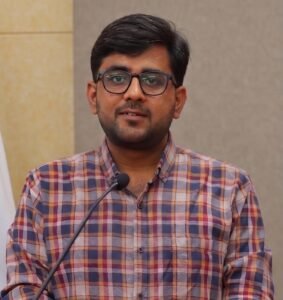
Arpit Awasthi is a doctoral researcher at the School of Design Innovation, Mahindra University, Hyderabad, working to extend the frontiers of ‘designerly ways of thinking’ beyond aesthetics and visual form toward some of India’s most wicked challenges in governance, public policy implementation, and state capacity. He seeks to reframe design thinking and systems thinking, anchored in Indian knowledge systems, as a serious instrument for building culture-sensitive policy institutions and to operationalize India’s vast Indic civilizational wisdom in service of Viksit Bhārat 2047. He also serves as a senior local coordinator with South Asia Students for Liberty.
PROJECT
Ideological Change and Economic Reforms in India

Samrudha Surana is a PhD student in economics at George Mason University, and a Graduate Fellow with the F. A. Hayek Program in Philosophy, Politics, and Economics at the Mercatus Center. His research interests revolve around the political economy of liberalization in India, and how people can find non-state solutions to deal with conflict. Samrudha’s research projects explore the role of ideological change in discourse surrounding India’s liberalization in 1991. The project measures change in ideology in academic journals, bureaucratic committee reports, and parliamentary debates over the period 1947 – 2020, using LLMs to classify these documents on a rubric of less to more economic freedom.