
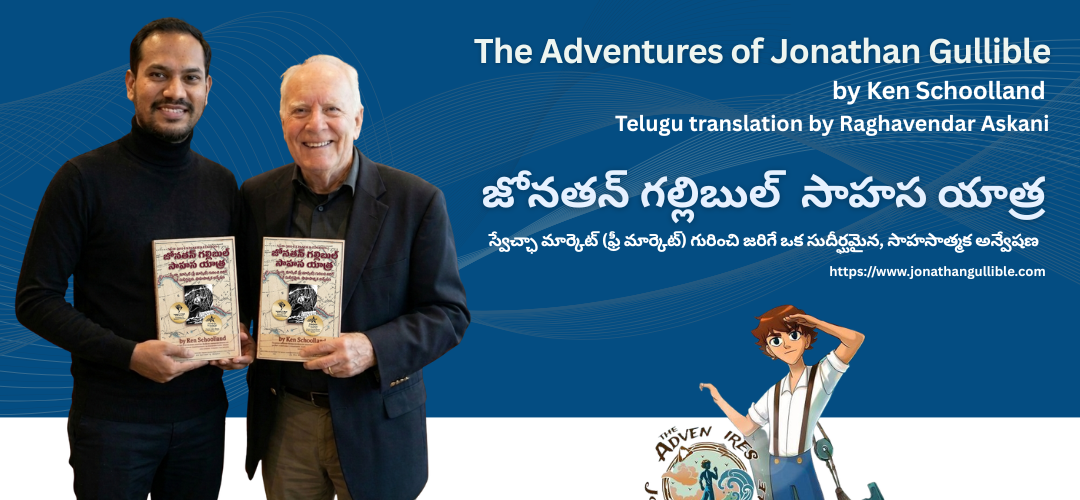

The Adventures of Jonathan Gullible is now available in Telugu, offering millions of readers in India and the Telugu-speaking diaspora a globally renowned tale of curiosity, freedom, and critical thinking. The Swatantrata Center launched this edition to promote ideas of liberty and everyday decision-making through engaging storytelling.
It’s not a textbook. Jonathan, the main character, wanders into societies built on odd rules and assumptions and starts asking questions most adults have learned to stop asking. Why can’t people choose for themselves? Who actually benefits when a rule claims to protect everyone? What happens when nobody pushes back on that?
Ken Schoolland wrote the original The Adventures of Jonathan Gullible decades ago. He’s an economist and educator who has taught at Hawaii Pacific University. He wanted to explain economic ideas without the usual jargon, so he used a story instead of a theory, and it’s since been translated into more than 60 languages, which says something about how well that worked.
Raghavendar Askani, an Indian classical liberal, social activist, and columnist, translated the book into Telugu. He founded the Youth Parliament Program and co-founded the Swatantrata Center, a liberal public policy think tank in India. His translation brings the book to over 96 million Telugu speakers, primarily in Andhra Pradesh and Telangana, and to global Telugu readers.
None of this is abstract for Indian readers. Jobs, schooling, starting a business, regulation, welfare, how much say government should have in daily life. These come up constantly, in dinner-table arguments as much as in newspapers. Jonathan’s travels turn those debates into something you can follow through a character rather than a policy brief, which is probably why the book has stuck around as long as it has instead of aging out like most economics writing does.
The Telugu translation matters for another reason too. Ideas land differently depending on the language you first meet them in. “Freedom” in English is one thing. The same idea in Telugu, filtered through phrases and references that are already familiar, is another. It stops being a term you memorized in school and starts being something you can actually picture happening to your own family, your workplace, or your neighborhood.
For students, teachers, and parents, that’s really the opening here: a way into conversations usually treated as too dense to bring up casually. Jonathan doesn’t arrive with conclusions already worked out. He notices things that don’t add up and figures it out as he goes, and that tends to land better with young readers than being told what to think. It also fits a generation that’s grown up online, comparing notes across borders, and generally less willing to just accept an answer because an adult gave it to them.
The reach goes beyond Andhra Pradesh and Telangana too. Telugu speakers live across the US, the Gulf, Europe, and Australia, and for those families the book can do two things at once: a language lesson, and a way to talk with kids about fairness and power without it feeling like a civics class. A parent overseas trying to keep their kid’s Telugu alive now has a book that also gives them something to actually discuss afterward.
The book doesn’t push a conclusion, and that’s worth sitting with for a second, because so much writing on this subject does the opposite. It asks readers to look at what a rule actually does once it meets real people, not just what it claims to do on paper. Something that reads as protection from one angle can look like a wall from another. A subsidy that helps one family might be quietly squeezing out another. A regulation meant to keep people safe might be the same regulation keeping someone from opening a shop. The book doesn’t resolve these tensions for you. It just makes sure you notice them.
That’s the audience, really. A college student annoyed at limited options. A parent trying to explain responsibility to a kid without turning it into a lecture. A small business owner buried in paperwork they didn’t expect. A teacher looking for something other than a textbook chapter to spark a classroom discussion. None of these people need to know the word “libertarian” or care about political labels at all. They just need a story that treats them as capable of thinking it through themselves.
The Telugu edition doesn’t change what the book is. It just means more people can actually read it the way it was meant to be read, in a language that doesn’t feel like a translation of someone else’s argument, and that difference matters more than it might sound like on paper.




I’m so pleased to see this in Telugu and curious the read thoughts of response. Mahalo