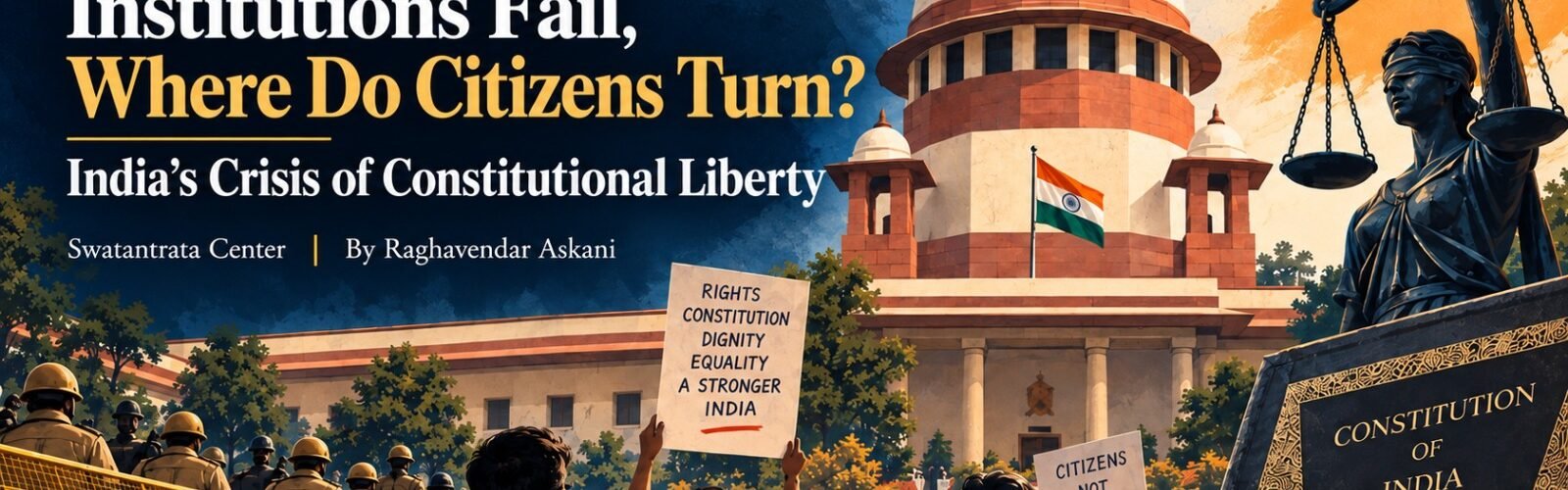

An unsettling question is raised by the decline in public confidence in the police, judiciary, and democratic institutions: Who will defend the people if those tasked with upholding our constitutional rights fail? What India needs to do next and why years of appeals against police brutality have not resulted in long-term accountability.
By Raghavendar Askani | Co-Founder & Director, Swatantrata Center
We Warned About This Years Ago
In 2021, I wrote to then Chief Justice of India N. V. Ramana on behalf of the Swatantrata Center. Our appeal was straightforward: take suo motu cognisance of police brutality and establish a model code of conduct to protect citizens from arbitrary force, humiliation, and abuse.
We described people being beaten with lathis during COVID-19 restrictions, including those travelling for essential needs. We invoked Article 21, the right to life and personal liberty, and reminded the Court of its own safeguards in D. K. Basu and Prakash Singh. The letter was copied to judges of the Supreme Court and chief justices across India.
That appeal was part of our Campaign for Civil Liberties, launched on October 2, 2021, to defend constitutional rights through public awareness, dialogue, and institutional reform. We were not asking for favors. We were asking public authorities to honor the Constitution.
Five years later, the same questions return with greater urgency. Police violence, preventive detentions, restrictions on peaceful assembly, and allegations of custodial abuse remain familiar headlines. Citizens protest, advocates petition courts, and judges issue directions. Then another incident occurs.
We must ask whether this is still a failure to recognize the problem or a failure to make institutions answer for it.
Court Orders Without Consequences
On October 9, 2026, the Supreme Court addressed restrictions imposed ahead of demonstrations in Delhi. Yet on October 10, protesters faced barricades, detentions, and disrupted transport. On October 11, the Court again intervened, directing authorities to prevent unlawful detention and respect for freedom of movement while preserving public order. It also sought responses concerning alleged noncompliance with earlier directions.
The intervention matters. It shows that judicial remedies still exist. But it also exposes their limits: a constitutional order is only as effective as the institutions that carry it out.
India has been here before. The Supreme Court laid down arrest safeguards in D. K. Basu v. State of West Bengal and ordered sweeping police reforms in Prakash Singh v. Union of India in 2006. Yet compliance with police reforms remains contested two decades later.
When officials can treat judicial directions as temporary inconveniences, citizens are left fighting the same battles repeatedly. Judicial independence must be defended; so must mechanisms that secure compliance, investigate violations, and remedy harm.
October 10: Whose Freedom Was Protected?
The Cockroach Janta Party (CJP) protests demanding accountability from Chief Election Commissioner Gyanesh Kumar became a test of those promises. Thousands were detained amid sweeping restrictions in Delhi. Lawyers, journalists, students, and other citizens reported being stopped or taken into custody. CJP leaders Abhijeet Dipke, Saurav Das, and Ashutosh Ranka were detained after arriving at Delhi airport before reaching the protest.
Police maintained that their measures were necessary for public safety and to enforce restrictions on the gathering. Public order is a legitimate responsibility. But preventive powers cannot become a convenient means of preventing peaceful political participation. Restrictions must be lawful, necessary, and proportionate.
An equally troubling issue arose around the response to counter-protesters. Journalists reported attacks on protesters, including women, by men associated with right-wing groups, with allegations that nearby police failed to intervene promptly.
Beyond One Detention
CJP legal affairs head Ratna Singh alleged that officers wrongfully confined her as she attempted to join a lawyers’ protest. A Delhi trial court rejected her requests for an FIR and relief on procedural grounds, including missing details and an affidavit. That ruling did not determine that the police acted lawfully.
The question is bigger than one litigant. Thousands were detained around the demonstrations, while broader allegations of coercive policing, harassment, and people being taken away without timely information to families intensified anxiety.
Not every detention is illegal, and serious allegations require evidence. But Articles 19, 21 and 22 protect peaceful assembly, personal liberty and safeguards against arbitrary arrest. Those protections mean little if people cannot quickly establish where a detained family member is or challenge an unjustified restriction.
When Lawyers Lose Hope
Senior advocate Kapil Sibal voiced the frustration many citizens feel, saying he was tired of repeatedly going to the Supreme Court and had little hope of relief.
His remarks are an opinion, not a verdict on every judge. Indeed, the Court’s October 11 intervention demonstrates that judicial scrutiny remains indispensable.
But we should take the warning seriously. If a senior constitutional lawyer questions the effectiveness of remedies, how does a street vendor, student, or daily-wage worker experience the justice system?
Respect for the judiciary must include an insistence on timely hearings, clear reasoning, equal treatment, and enforceable outcomes. Public confidence cannot be sustained by declarations alone.
A Wider Measure of Institutional Decline
International assessments reinforce these concerns, though their methodologies differ.
The World Justice Project’s 2025 Rule of Law Index placed India 86th of 143 countries, including 103rd for fundamental rights and 114th for civil justice. Freedom House’s 2026 report rated India Partly Free, at 62 out of 100. Reporters Without Borders ranked India 157th of 180 in its 2026 Press Freedom Index.
These rankings do not decide any legal case. They do, however, challenge the comforting idea that regular elections and economic growth automatically guarantee liberty.
Women’s Safety Is Part of the Same Failure
The reported assaults on female protesters make a basic principle urgent: women do not surrender their right to safety by entering public life or expressing unpopular views. Police must protect them regardless of political affiliation.
The problem extends well beyond demonstrations. National Crime Records Bureau figures recorded 441,534 cases of crimes against women in 2024, while the India Justice Report 2025 identified persistent weaknesses in police capacity and women’s representation.
Protection requires responsive police stations, credible investigations, survivor support, and timely trials, not only condemnations after violence. The same institutional indifference that endangers protesters, can fail women, marginalized communities, and people without political influence.
Reform the System, Not Merely the Government
This crisis will outlast any election unless we confront its structural causes. Governments of different parties have had years to implement Prakash Singh, including independent Police Complaints Authorities and safeguards against political interference. Too often, they have retained the convenience of controlling the police while promising reform.
The Emergency of 1975–77 reminds us how fragile liberty becomes when institutions fail to resist executive power. India is not under a formally declared national Emergency today; that historical distinction matters. But so does the obligation to challenge arbitrary state action before it becomes normal.
What should change?
First, implement police reforms with independent complaints bodies empowered to examine excessive force, custodial abuse, and protest-related misconduct. Publish findings and disciplinary outcomes.
Second, make judicial orders enforceable through time-bound compliance reports, public monitoring, and appropriate sanctions for deliberate defiance. Victims need remedies, not another promise to review procedures.
Third, create genuinely urgent pathways for habeas corpus petitions, detention challenges, and credible complaints of police violence. Legal aid must work for citizens without money or connections.
Fourth, protect peaceful protest through clear, proportionate rules. Record detentions, notify families promptly, preserve footage, and independently review significant uses of force. Officers must intervene against violence from supporters and opponents alike.
Fifth, treat women’s safety and civil liberties as measures of institutional performance. Parliament and state legislatures should regularly publish and scrutinize data on complaints, delays, court-order compliance, and reform implementation.
Finally, build sustained cooperation among lawyers, journalists, researchers, universities, and civil society to document abuses, assist victims, and track whether promised reforms actually happen.
The Appeal We Should No Longer Have to Make
Our 2021 appeal to the Supreme Court asked for something elementary: treat every person with dignity, and prevent police powers from becoming instruments of humiliation or fear. We should not still be asking the same question after every lathi charge, detention, or protest.
The Supreme Court must remain a defender of constitutional liberty. But judgments cannot protect people by themselves. Police chiefs, governments, legislatures, and administrators must be accountable for carrying them out.
This is not an argument against the state or the courts. It is an argument for institutions strong enough to restrain power, whoever holds it.
The true measure of India’s democracy is whether an ordinary person can challenge official wrongdoing and obtain a fair, timely, effective remedy. Until that becomes routine rather than exceptional, the promise of constitutional freedom remains unfinished.
How many more appeals should citizens have to make before their rights are protected in practice